Business and personal money, kept apart
Personal finance tracker for freelancers
Keep freelance income in its own financial context, separate from household money, and plan against it when the amount changes every month.
Last updated 2026-09-01
Freelancing breaks two assumptions most personal finance tools are built on: that income arrives on the same day each month in roughly the same amount, and that there is only one pot of money.
Neither holds. A good month and a thin month look nothing alike, and the money that lands in your account is not all yours to spend — some of it is tax, some is expenses, and some belongs to next month.
Rinalance handles this with separation rather than automation.
Business money stays in its own context
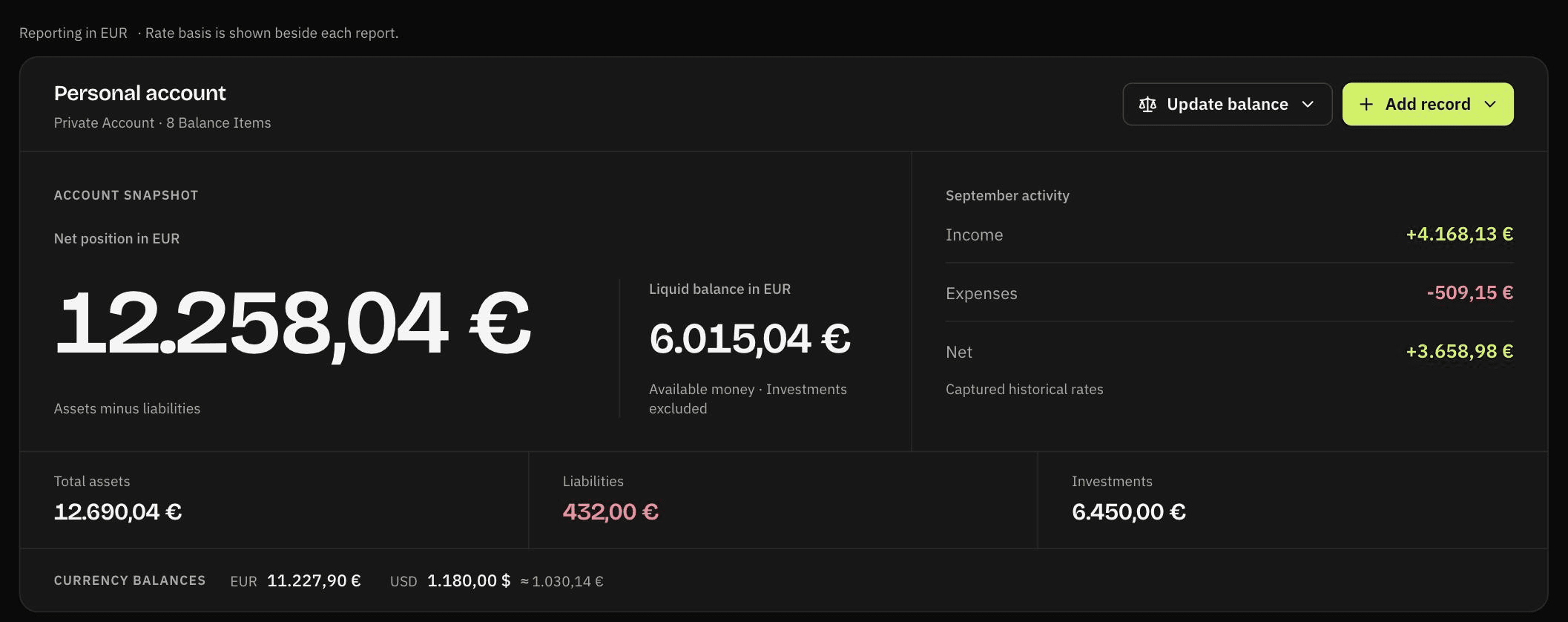
An account in Rinalance is an isolated financial context. Personal is one. Business is another. They are never combined into a single dashboard, and there is no aggregate total across them — you switch between contexts instead of filtering one large pile.
This is a deliberate constraint rather than a missing feature. The moment a tool blends a client payment into household spending, both numbers stop meaning anything: your business revenue is buried in groceries, and your personal spending looks like it exploded in the months you got paid well.
Keeping them apart means you can answer two separate questions honestly — how the business did, and what you actually spent — instead of one blurred one.
Paying yourself is a transfer, not income
When you move money from the business account to your personal one, that is not new income and it is not spending. It is the same money changing hands.
Rinalance records it as a transfer: one action creating linked records on both sides, decreasing one balance and increasing the other atomically. It never appears in income or expense totals on either side.
That sounds like a small detail until you have done it the other way. In a tool without proper transfers, paying yourself €2,000 inflates personal income by €2,000 and business expenses by €2,000, and by December your annual figures are meaningless.
Budgeting when the number changes every month
Traditional budgeting advice assumes a fixed salary. Most freelance budgeting advice then tells you to "budget on your lowest month", which is correct and almost nobody does it.
What tends to work better in practice is planning against categories rather than against a total, and reviewing monthly rather than annually. Rinalance supports that with monthly category budgets on Premium: a limit per category, tracked against what you actually recorded, reset each month.
The useful part is not the limit. It is the comparison — seeing that software cost €373 more this month than last, or that groceries barely moved while transport doubled. A month-on-month category view answers "what changed?", which is the question that actually leads to a decision.
Alongside it, cash-flow forecasting builds a picture from what you already know is coming: scheduled subscriptions, recurring commitments, and your spending history. On an irregular income, knowing what is due before the next payment lands is worth more than any budgeting method.
Debts and receivables, in both directions
Freelancing generates money owed in both directions — an invoice not yet paid, a piece of equipment bought on terms, a loan from family during a slow quarter.
Rinalance tracks both. Money owed to you attaches to a receivable; money you owe attaches to a liability. Each carries the counterparty, the dates, and repayments recorded against it, and both feed a net position rather than sitting in a separate list that never affects your totals.
Repayments behave correctly: paying down principal reduces both the paying asset and the liability, and is not counted as an expense. Interest and fees are. A repayment coming in increases the asset and reduces the receivable, and is not counted as new income.
What this is not
It is not invoicing. There is no way to create, send, or chase an invoice.
It is not bookkeeping or accounting software. Business here means a boundary between contexts, not a chart of accounts, not double-entry, and not something your accountant will work from.
It does not calculate or set aside tax. It will not tell you what you owe, and it will not ring-fence anything automatically. You can track a tax reserve as its own asset and move money into it deliberately — which many people prefer anyway — but the discipline is yours.
If you need invoicing and tax handling, use dedicated software for that and use this for the question it answers: where does the money actually stand, across both sides of your life, right now.
What this does not do
- Rinalance is not invoicing, bookkeeping, or tax software.
- It does not calculate tax owed or set money aside automatically.
- Budgets and forecasting are Premium features.