Money in more than one currency
Multi-currency personal finance tracker
Track balances in fifteen currencies, including every EU currency, inside one selected account. Each balance item keeps its own currency, with current positions shown in the account's reporting currency.
Last updated 2026-09-30
Most personal finance apps assume you live in one currency. You pick it at signup, and everything afterwards is denominated in it. That works until you have a salary in euro and a card in dollars, or you moved countries and kept the old account open, or half your clients pay in a currency you do not spend.
At that point single-currency tools force a choice: convert everything by hand or keep a second tracker for the other currency.
Rinalance holds EUR, USD, GBP, CHF, JPY, CAD, AUD, PLN, CZK, HUF, RON, SEK, DKK, NOK, and ISK at the same time.
Each balance item keeps its own currency
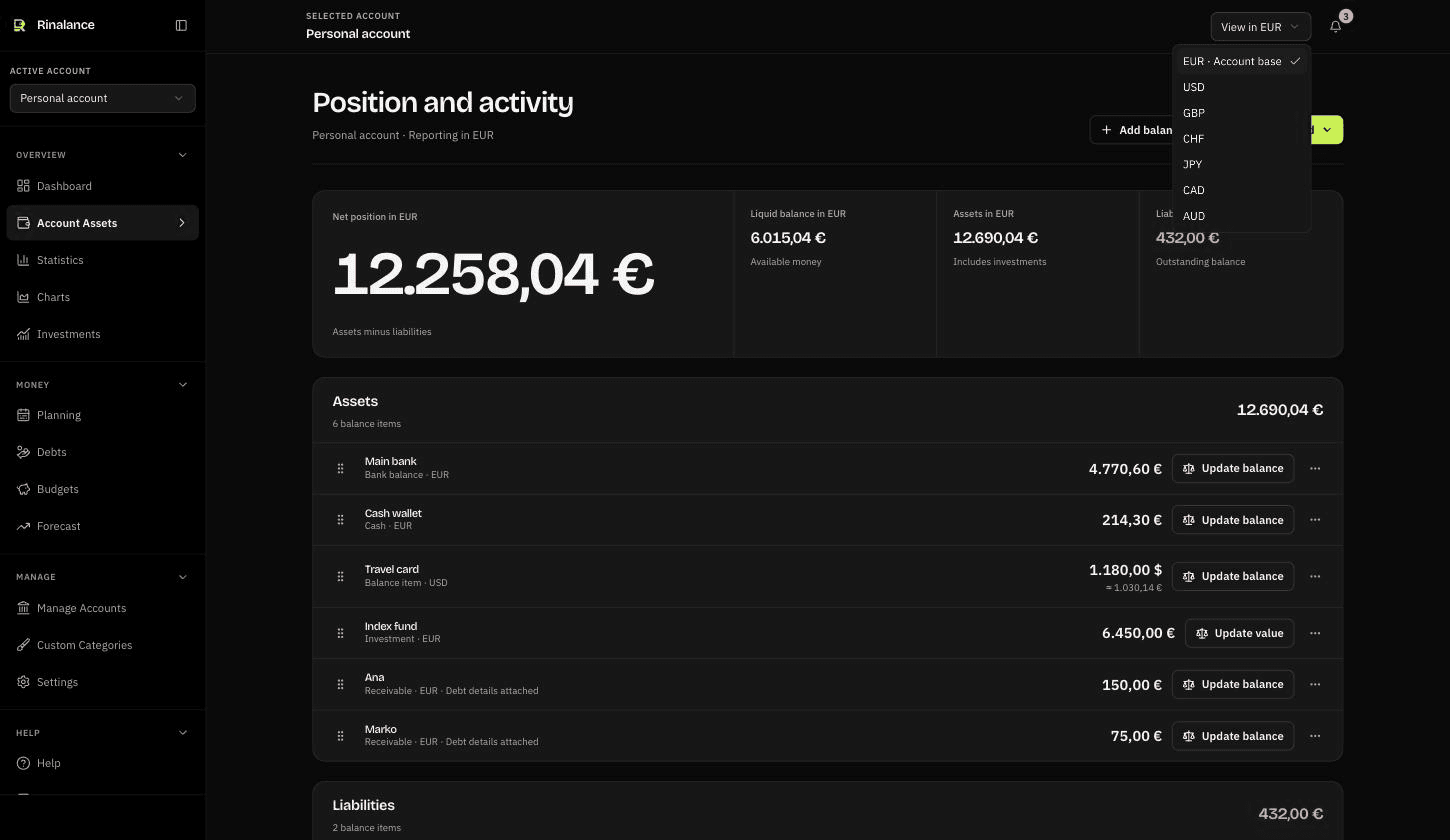
Currency belongs to each balance item. An account also has a base currency for reporting.
A euro bank balance holds euro. A dollar travel card holds dollars. A yen balance from a trip holds yen. Rinalance preserves each original amount. When you record activity against a balance item, it keeps that item's currency.
The selected account's current position uses its base reporting currency. You can temporarily view a report in another supported currency, labeled as a current-rate estimate. Switching accounts or reloading resets that view. There is no combined total across separate accounts.
Where the rates come from
Exchange rates are fetched server-side and cached, and each stored rate records which provider it came from and when. Where a saved rate is stale, it is labelled as stale rather than silently presented as current.
Current positions use the latest known rate. Historical activity reports use the rate captured for the transaction date. A temporary alternate-currency view uses current rates, so do not treat that view as a dated historical conversion or a tax report.
Rinalance never exchanges or sends money. A transfer record tracks movement that you made elsewhere; it does not execute a payment.
Accounts, assets, and what counts as yours
Multi-currency work sits on top of a straightforward model.
An account is an isolated financial context — Personal, Business, or whatever separation you need. Accounts are never merged into one combined total; you switch between them.
Inside an account, assets are the things holding value: cash, bank balances, prepaid and debit cards, and investments. Liabilities are what you owe: credit card balances, loans, money owed to someone.
From those, Rinalance derives:
- Liquid balance — money you could actually spend
- Investments — counted toward total assets and net position, but deliberately not toward liquid balance
- Net position — total assets minus total liabilities
Credit limits and available credit are shown as information and never counted as money you own, which is a small thing that a surprising number of tools get wrong.
Who ends up needing this
People who moved countries and kept a balance in the old currency. It can appear in the selected account's net position without changing its original amount.
Freelancers with foreign clients. If income arrives in dollars and expenses leave in euro, the selected account can report both without rewriting their original currencies. Rinalance does not manage invoices or taxes.
People who travel often enough to hold a second card. A travel card with a leftover balance is an asset, not a rounding error.
Anyone holding an investment denominated elsewhere. It belongs in your net position even though you do not spend in that currency.
If any of those describes you, ask whether your current tool can show one account's net position across the currencies it holds without changing the original balances.
What it is not
It is not an FX tool. It will not tell you when to convert, and it has no view on rates.
It is not a trading or brokerage account. Investments are tracked as values you enter, not as live positions.
Historical activity reports use captured rates. Temporary alternate-currency views use current-rate estimates and do not replace formal accounting or tax reports.
What this does not do
- Alternate currency views are current-rate estimates, not historical revaluations.
- Fifteen currencies are supported. Others are not.
- Rinalance does not move money or execute any exchange.