App comparison
YNAB alternative: how Rinalance compares
How Rinalance compares to YNAB on method, price, bank sync, currencies, and sharing. One is zero-based budgeting at $109 a year; the other is balance-first tracking with a free plan.
By Marko Uremovic · Last updated 2026-09-30
YNAB is the most opinionated budgeting app that exists, and that is the point of it. It teaches a method — give every dollar a job before you spend it — and the method works for a great many people. If you are looking at alternatives, it is usually for one of three reasons: the price, the single-currency limit, or the realisation that you want to track money rather than allocate it.
Rinalance addresses the second and third. On the first it is cheaper, but that is the least interesting difference.
What YNAB does
YNAB is zero-based budgeting: income arrives, you assign all of it to categories, and you spend from those categories. When one runs dry, you move money from another. The discipline is the product, and the app is unusually good at teaching it — the 34-day trial, the workshops, the community.
It costs $14.99 a month or $109 a year, priced in US dollars wherever you live. Bank import covers select US, Canadian, UK, and EU banks, with file import elsewhere, and manual entry is fully supported. One subscription can be shared with up to six people.
Rinalance and YNAB side by side
| Feature | Rinalance | YNAB |
|---|---|---|
| Budgeting method | Records update balances first. Monthly category budgets are a Premium layer on top. | Zero-based budgeting. Every dollar is assigned a job before it is spent. |
| Price | Free plan. Premium is €4.99 per month. | $14.99 per month or $109 per year, in US dollars. 34-day free trial. |
| Bank connection | None on any plan. Every record is entered by you. | Direct import for select US, Canadian, UK, and EU banks. File import elsewhere. Manual entry also supported. |
| Currencies | Fifteen currencies within a selected account. Current positions use its reporting currency. | One currency per plan. Multiple currencies cannot be used together. |
| Sharing | One person, one login. No shared access. | Up to six people on one subscription. |
| Separate contexts | Personal, Business, and other accounts stay separate and are never merged into one total. | Multiple plans are possible, but one plan is the norm. |
| Platforms | Web, installable from supported browsers. | iOS, Android, and web. |
YNAB plan details and pricing checked on 2026-09-19 against their own site. Prices change, so verify before you decide.
The real difference is what you are doing with the app
YNAB is a budgeting tool. Its central question is "what is this money for?" You answer it before spending, every time, and the app's whole design exists to make you keep answering it.
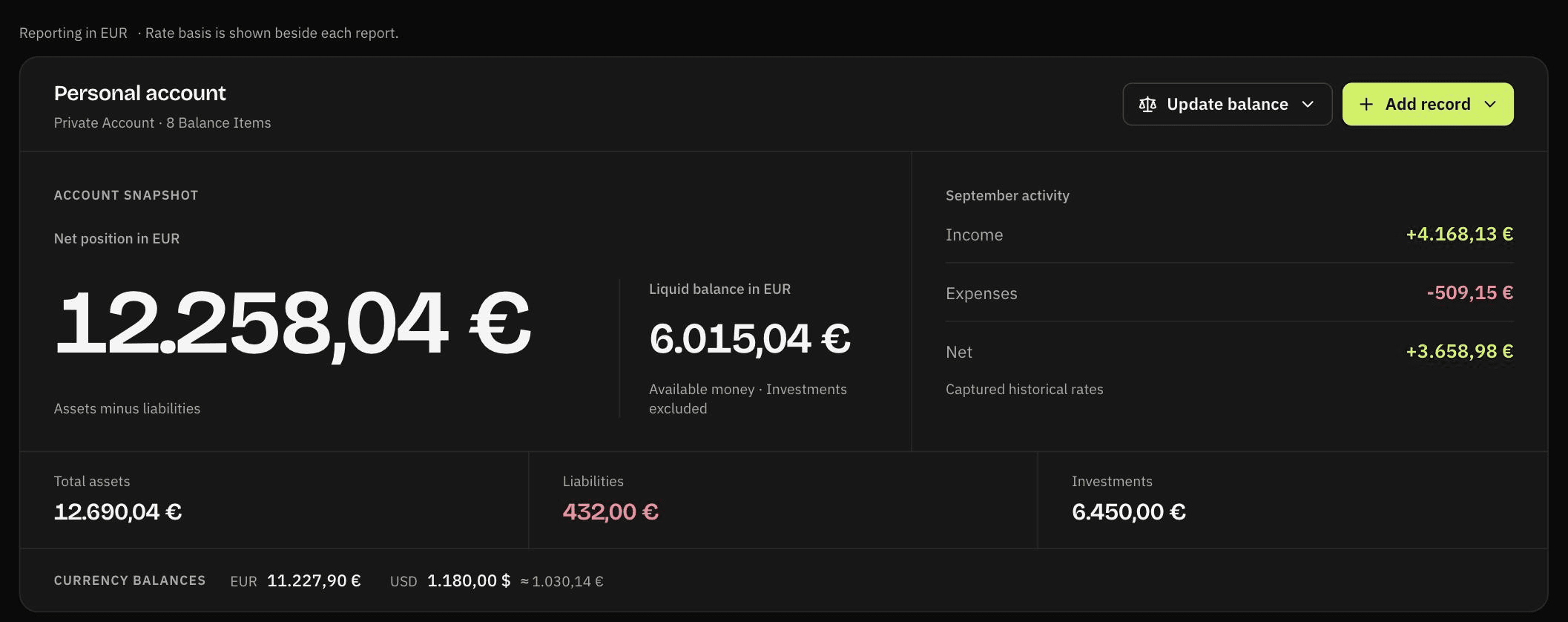
Rinalance is a tracking tool. Its central question is "where does my money actually stand?" You record what happened — income, expenses, transfers between your own accounts — and every balance, category total, and month-on-month comparison follows from those records. Monthly category budgets exist on Premium, but they sit on top of the ledger rather than replacing it.
If you have tried YNAB and found yourself fighting the method rather than using it, that is not a character flaw. Some people want to allocate, and some people want to know. These are different tools for different questions.
Where Rinalance is the better fit
You hold more than one currency. YNAB's own documentation is direct: you pick one currency per plan and cannot use several together. Rinalance supports fifteen currencies within a selected account, including every EU currency. Each balance item keeps its own currency, while current positions use the account's reporting currency. If you have a salary in euro and a card in dollars, this may decide it.
You want to keep contexts separate. A Rinalance account is an isolated financial context — Personal, Business, or anything else — and accounts are never merged into one combined total. Freelance income does not blur into household spending.
You want no bank connection at all. YNAB offers sync and also supports manual entry. Rinalance does not offer sync on any plan, which some people want as a guarantee rather than a setting.
You want a free plan that does not expire. YNAB's trial is generous but ends. Rinalance's Free plan tracks unlimited manual records indefinitely, with limits on accounts, balance items, and Scheduled Activity rather than on time.
You are priced in euro. Small thing, but a USD subscription for a European user carries an exchange-rate drift and a foreign-transaction fee every month.
Where YNAB is the better choice
The method is what keeps you honest. If zero-based budgeting is the thing that finally made money make sense, do not leave it for a tool that does something else. Rinalance does not do envelope or zero-based budgeting, and adding it would break the model.
You share a budget. YNAB supports up to six people on one subscription. Rinalance is one person, one login, with no shared-access feature at all.
You want optional bank import. It is there in YNAB for supported regions. It is not in Rinalance and not planned.
You want the education. YNAB's workshops and community are a real part of the product. Rinalance has guides; it does not have a movement.
Moving from YNAB
One thing to know up front: Rinalance has no file import. YNAB exports, but nothing reads that file on this side. Switching means starting from today — enter each account's current balance, add your subscriptions and any debts, and record forward from there. For most people that is twenty to thirty minutes.
Keep your YNAB export as an archive. Your history does not disappear; it just does not migrate.
Which one to pick
Choose YNAB if the zero-based method is why your finances work, if you share a budget, or if you want bank import.
Choose Rinalance if you hold more than one currency, if you need personal and business money kept separate, if you want to track rather than allocate, or if you want a manual tracker with no bank connection and a free plan that does not expire.