Method comparison
Spreadsheet vs budgeting app: how Rinalance compares
Honest comparison between tracking money in a spreadsheet and using Rinalance. Spreadsheets win on flexibility and cost; the app wins on the things that break in a spreadsheet after month three.
By Marko Uremovic · Last updated 2026-09-30
A spreadsheet is the most popular personal finance tool in the world, and it deserves to be. It is free, it is private, it does exactly what you tell it, and a great many people are running one right now that works. If yours works, this page is not trying to talk you out of it.
It is written for the other case: the spreadsheet that worked for three months and then quietly stopped being true.
Why spreadsheets win
Be fair about this first.
They cost nothing. No subscription, no plan limits, no upgrade prompt.
They are completely flexible. Any layout, any formula, any chart. A spreadsheet can model a situation no app has thought of, because it does not need to have thought of it.
They are private by construction. The file is wherever you put it. No account, no hosting, no company in the middle.
You already know how to use one. There is nothing to learn.
If those four things are what matter most, and you enjoy the maintenance, keep the spreadsheet. Genuinely.
Rinalance and a spreadsheet side by side
| Feature | Rinalance | a spreadsheet |
|---|---|---|
| Cost | Free plan. Premium is €4.99 per month. | Free, or whatever your office suite already costs. |
| Transfers | One action creates linked records on both sides. Never counted as income or spending. | Two rows you must keep in agreement by hand, and the most common source of double-counting. |
| Balances | Follow from the records automatically. | A formula per account that must stay correct as rows change. |
| Currencies | Seven, converted from cached rates that record their source. | Whatever you build, with rates you look up and paste yourself. |
| Flexibility | Opinionated. Some layouts are not possible on purpose. | Unlimited. Any layout, any formula, any chart. |
| Where your data lives | Hosted. Encrypted in transit and at rest, not end-to-end. | Wherever you put the file. |
| When you skip a month | Nothing breaks. Pick up where you left off. | A new tab to copy, ranges to fix, and a gap in every chart. |
The spreadsheet column describes a typical hand-built sheet rather than any product. Your own may be better or worse.
Where spreadsheets break
The failure is rarely the first month. It is the pattern that emerges by the third.
Transfers. Moving €300 from your current account to savings is one event, but in a spreadsheet it is two rows in two tabs that must agree. Miss one and your spending is wrong; enter both as expenses and you have "spent" money that is still yours. This is the single most common reason spreadsheet totals drift, and it is structural — the sheet has no idea the two rows are the same money.
Balances. Every account balance is a formula that must survive every row you add, delete, or reorder. It survives most of them. The one it does not is the one you find in month four, when the number is wrong and you cannot say since when.
The new month. Copy the tab, fix the ranges, carry the closing balances forward, notice the chart now points at the wrong cells. Twenty minutes, every month, and the month you skip it is the month the whole thing stops.
Currencies. Workable if you look up rates and paste them. Wrong the moment you forget, and silently wrong — the total still looks like a number.
Categories. A dropdown you built once, extended inconsistently, and now has "Groceries", "groceries", and "Food" as three different things.
None of these is a lack of skill. They are the cost of being the person who maintains the system as well as the person who uses it.
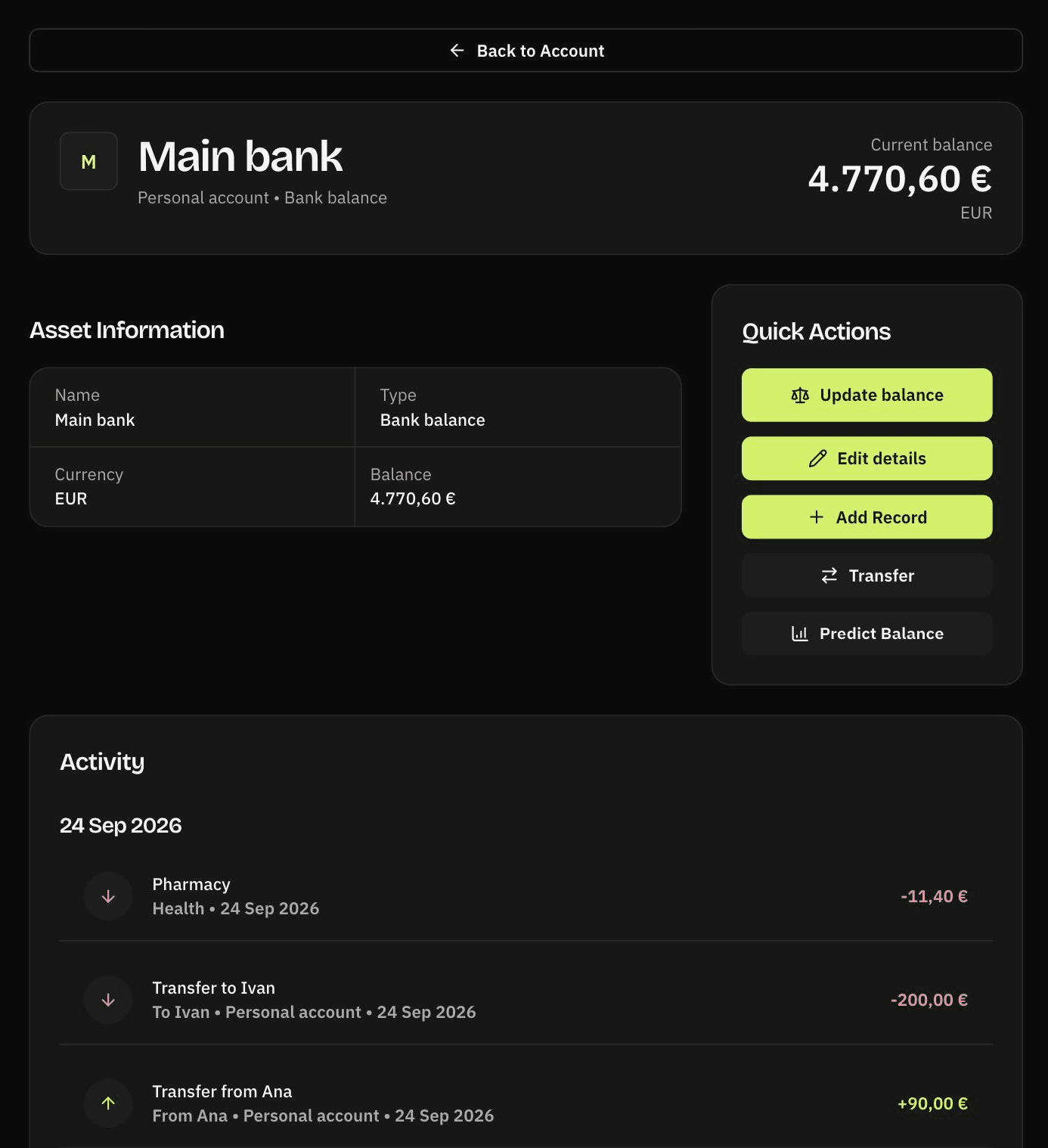
What Rinalance keeps, and what it removes
The point is not to replace manual entry with automation. Rinalance is manual too — you type in what happened, exactly as you would in a sheet. There is no bank connection on any plan.
What it removes is the bookkeeping around the entry:
- A transfer is one action that creates linked records on both sides and is never mistaken for income or spending.
- Balances follow from the records. There is no formula to protect.
- Nothing happens at month end. Categories, charts, and month-on-month comparisons are already connected.
- Fifteen currencies convert automatically from cached rates that record their provider and date.
- Skipping a week breaks nothing. You pick up where you left off, and the gap is just a gap.
What it removes with that is flexibility. Rinalance is opinionated — accounts are separate contexts and never merge, transfers are transfers, investments count toward net position but not liquid balance. Some layouts you could build in a sheet are not possible here, and that is deliberate.
What you give up
Total control of the file. Rinalance is hosted. Your records are encrypted in transit and at rest, but they live in our infrastructure, not on your disk, and that is not end-to-end encryption. If "the data never leaves my machine" is a requirement rather than a preference, a spreadsheet or a local-first tool like Actual Budget is the honest answer.
Free forever with every feature. The Free plan is real and does not expire, but budgets, custom categories, and cash-flow forecasting are Premium at €4.99 a month.
Importing what you have. Rinalance does not read spreadsheets. Moving over means entering current balances and recording forward, not uploading your history. Keep the sheet as an archive.
The honest test
Open your spreadsheet and check whether the balances in it match your actual accounts today. Not roughly — exactly.
If they do, and they have for the last three months, you have a working system and no reason to change it.
If they do not, and you are not sure when they stopped, that is the thing a tracker is for.
Which one to pick
Keep the spreadsheet if it is accurate today, you enjoy maintaining it, you need a layout no app offers, or your data must never leave your machine.
Choose Rinalance if the sheet has drifted, if transfers and month-ends have become the reason you stopped updating it, if you hold more than one currency, or if you want the manual entry without being the one who keeps the formulas alive.