App comparison
Mint alternative: how Rinalance compares
Mint closed in March 2024 and its remaining features moved to Credit Karma without budgets or custom categories. What Rinalance does instead, and what it does not.
By Marko Uremovic · Last updated 2026-09-30
Mint shut down on 23 March 2024. Intuit moved some of its features into Credit Karma and retired the rest — including monthly budgets and custom categories, which were the two things most people used it for.
If you are still looking for a Mint alternative more than two years later, it is probably because the obvious replacements did not fit. So this page is less a comparison than an honest description of what Rinalance is, what Mint was, and why they are not the same kind of thing.
What Mint was
Mint was free. You connected every bank account, card, and loan, and it aggregated all of them into one view, categorised transactions automatically, and let you set budgets against the categories. It paid for itself by showing you offers for credit cards and financial products based on what it saw in your data.
That model — free, automatic, ad-supported — is what ended. Intuit's own page now reads "Mint has been reimagined on Credit Karma," and Credit Karma is where the aggregation and net-worth features went. Budgets and custom categories did not make the trip.
Rinalance and Mint side by side
| Feature | Rinalance | Mint |
|---|---|---|
| Status | Active, hosted, and charging for Premium rather than showing ads. | Shut down on 23 March 2024. Some features moved to Credit Karma. |
| Price | Free plan. Premium is €4.99 per month. | Was free, supported by advertising and offers. |
| Bank connection | None on any plan. You enter what you choose. | Automatic aggregation of every linked account was the product. |
| Budgets | Monthly category budgets on Premium. | Available in Mint. Not carried over to Credit Karma. |
| Custom categories | Available on Premium. | Available in Mint. Not carried over to Credit Karma. |
| Your data | You decide what exists. Complete export on both plans. Account deletion removes it. | Everything from every linked account, used to target offers. |
| Ads | None. | The business model. |
Mint closed on 23 March 2024. The Mint column describes the product as it was; its current status was checked against mint.intuit.com on 2026-09-19.
The honest framing
Mint's whole premise was that you connected your bank and the app did the work. Rinalance's whole premise is that you do not connect your bank and you do the work.
That is not a small difference in features. It is the opposite bet.
If what you loved about Mint was that everything appeared automatically, Rinalance will feel like a step backwards, and you should look at Monarch, Copilot, or Credit Karma instead. Those are Mint's real successors.
If what you have concluded since Mint closed is that you would rather not hand any company ongoing read access to your accounts — or that the free-with-ads model ends the way it ended — then a manual tracker is a reasonable place to land, and Rinalance is one.
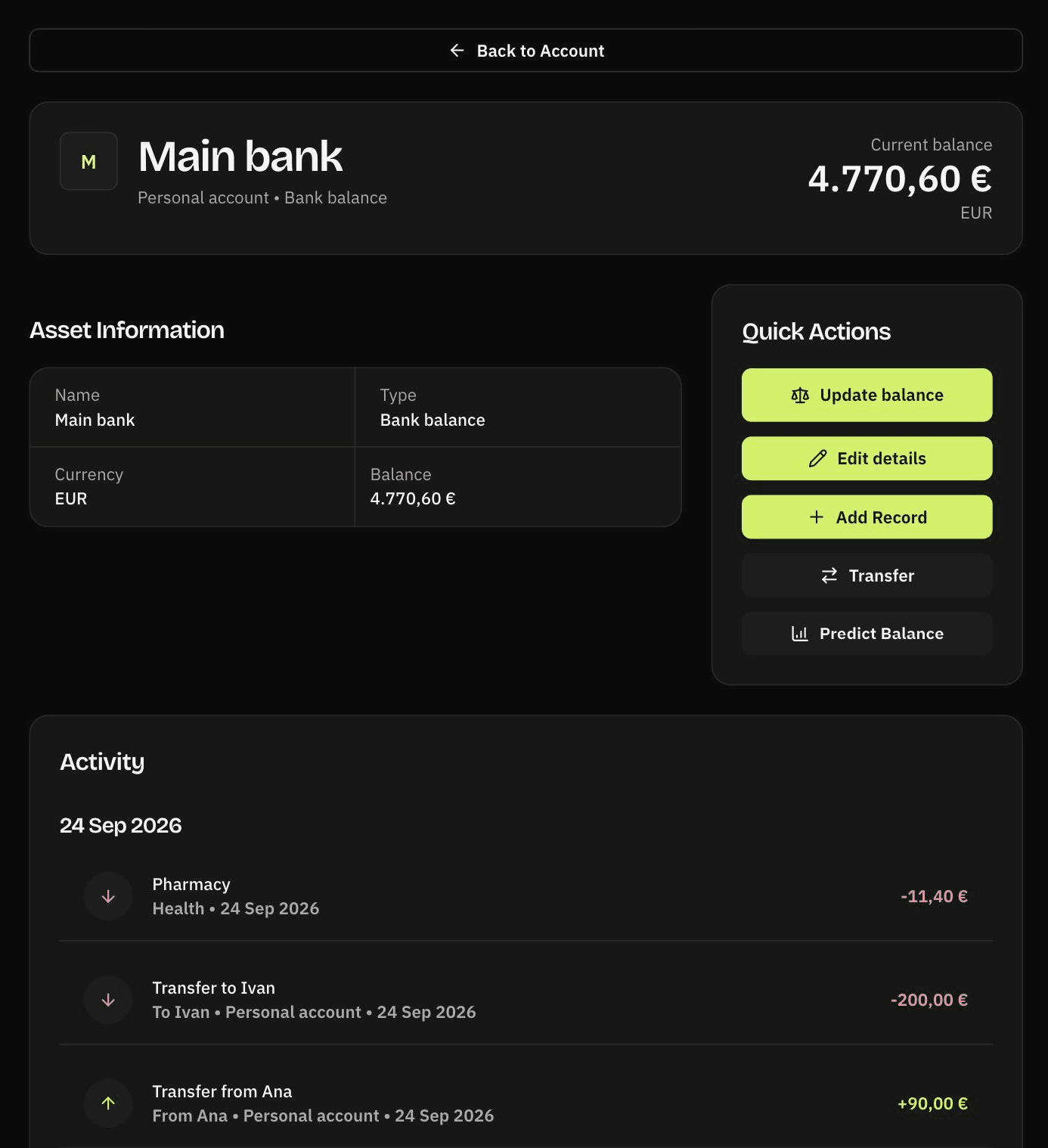
What Rinalance does that Mint did not
It does not ask for a bank login today. There is no aggregator or bank credential to store. You enter balances and transactions yourself, so the financial data in Rinalance is data you chose.
It keeps contexts separate. Mint merged everything into one view. Rinalance does the opposite by design: Personal, Business, and other accounts are isolated contexts that are never summed into a combined total.
It handles fifteen currencies. Every EU currency, plus GBP, CHF, NOK, ISK, USD, CAD, AUD, and JPY, with each asset in its own currency.
It charges instead of selling. Premium is €4.99 a month. There are no ads, no offers, and no business model that depends on what your transactions say about you.
It tracks debts and subscriptions as first-class things rather than as categories of transaction.
What Rinalance does not do that Mint did
Automatic anything. No sync, no import, no auto-categorisation. Every record is entered by hand.
Credit score. Mint showed it. Rinalance has no connection to any credit bureau.
Free forever with every feature. The Free plan is genuinely free and does not expire, but budgets, custom categories, and cash-flow forecasting are Premium.
Moving from Mint
If you still have a Mint export, keep it as an archive — Rinalance cannot import it, and nothing else in this comparison changes that. Start from today: enter each account's current balance, add subscriptions and any debts, and record forward.
Two years after the shutdown, most people who are still searching have already accepted that their Mint history is gone. What is left is choosing what kind of tool comes next.
Which one to pick
Choose Credit Karma, Monarch, or Copilot if you want what Mint was — free or paid, automatic, everything connected.
Choose Rinalance if the Mint experience is what you are trying to leave behind: if you want to see your money without connecting it, keep business and personal apart, hold more than one currency, and pay a small fixed amount rather than be the product.