App comparison
Lunch Money alternative: how Rinalance compares
How Rinalance compares to Lunch Money — the closest match on this list. Both are independent, euro-priced, and multi-currency. They differ on bank sync, import, and whether there is a free plan.
By Marko Uremovic · Last updated 2026-09-26
Lunch Money is the closest thing to Rinalance on this list, and this page should say so plainly. Both are independent, both are priced in euro, both take multi-currency seriously, and both were built by people who are visibly tired of finance apps that sell your data.
That makes the comparison narrower and more useful than most. The differences come down to three things: bank import, file import, and whether you pay from the first month.
What Lunch Money does
Lunch Money is a personal finance tracker used across thirty-plus countries, with direct bank import, CSV upload, a developer API, crypto wallet connections, monthly category budgets, recurring-expense tracking, and multicurrency support. It is built by an independent team with no investors, shows no ads, and states it will never sell data.
It costs €10 a month or €100 a year — and the annual price is set-your-own, with the listed figure as a default. There is a 30-day trial with no card required, and your price is locked for life at whatever rate you joined at. There is no free plan.
Rinalance and Lunch Money side by side
| Feature | Rinalance | Lunch Money |
|---|---|---|
| Price | Free plan that keeps working. Premium is €4.99 per month. | €10 per month or €100 per year, locked for life. 30-day trial, no card required. No free plan. |
| Bank connection | None on any plan. | Optional direct import from banks, plus crypto wallets. |
| File import | No import. Complete versioned JSON export with CSV files. | CSV upload, and a developer API for automation. |
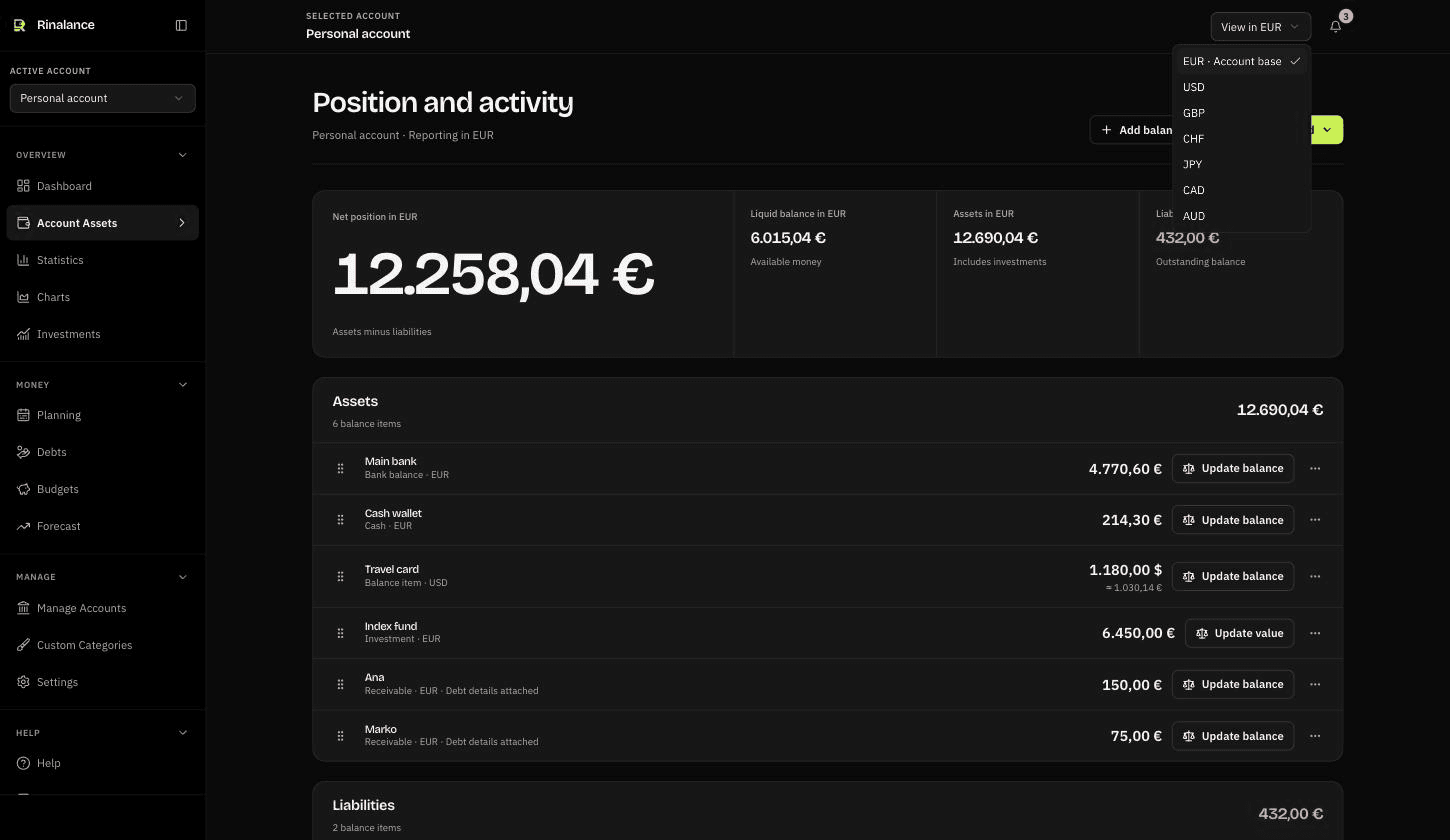
| Currencies | Fifteen currencies within a selected account, with original amounts preserved. | Multicurrency support across 30+ countries. |
| Separate contexts | Personal and Business accounts never merge into one total. | One workspace; categories and tags do the separating. |
| Who builds it | A small independent company in Croatia. No investors. | An independent one-person team. No investors, no ads, no data sales. |
| Platforms | Web, installable from supported browsers. | Web, with a companion mobile app. |
Lunch Money plan details and pricing checked on 2026-09-19 against their own site. Prices change, so verify before you decide.
Where they agree
It is worth listing, because it is most of the picture.
- Independent and investor-free. Both are small companies answerable to users rather than to a growth target.
- No ads, no data sales. Both charge a subscription instead.
- Multi-currency as a real feature, not a bolt-on. Both are built for people whose money crosses borders.
- Euro pricing. Neither charges Europeans in dollars.
- Manual entry is a first-class path, not a fallback.
If you are choosing between the two, you are choosing between two versions of the same philosophy. Neither is a mistake.
Where Lunch Money is the better choice
You want bank import as an option. Lunch Money offers direct import where it is supported, and manual entry where it is not. Rinalance offers manual entry only, on every plan, by design.
You have history in files. Lunch Money reads CSV. Rinalance does not read anything — export runs outward only. If you have years of transactions to bring across, that is decisive.
You want an API. Lunch Money has a developer API for automating imports and building on top of your data. Rinalance has none.
You track crypto. Wallet and ledger connections exist in Lunch Money. Rinalance tracks an investment as a value you enter.
You want a mobile app. Lunch Money has a companion app. Rinalance is a web app you can install from the browser.
Where Rinalance is the better fit
You want a free plan that stays free. Lunch Money's trial is generous, but after thirty days it is €10 a month. Rinalance's Free plan tracks unlimited manual records indefinitely, with limits on accounts, balance items, and Scheduled Activity rather than on time.
You want no bank connection on principle. Lunch Money makes it optional. Rinalance does not offer it at all. For some people the difference between "off" and "absent" matters.
You want contexts kept apart. Lunch Money is one workspace, organised with categories and tags. A Rinalance account is an isolated context — Personal, Business, or anything else — that is never merged into a combined total. If you have freelance money you would rather never see next to household money, this is the reason to look.
You want debts tracked as debts. Money you owe and money owed to you attach to the balance they belong to, with counterparties, due dates, and repayments — not as a category of transaction.
The price, honestly
Lunch Money at €100 a year against Rinalance Premium at roughly €60 a year is not a large gap, and Lunch Money's set-your-own annual pricing can close it further. If price is the deciding factor, the real difference is that Rinalance has a €0 tier and Lunch Money does not.
Both companies would rather you picked the one that fits than the one that is cheapest, and on this page that is easy to mean.
Moving between them
Lunch Money to Rinalance: no import. Enter current balances and record forward. Keep the export.
Rinalance to Lunch Money: both Rinalance plans include a complete versioned JSON export with CSV files. Lunch Money reads CSV, but this is not a one-click migration.
Which one to pick
Choose Lunch Money if you want bank import as an option, need to bring in existing files, want an API or crypto tracking, or want a native mobile app.
Choose Rinalance if you want a free plan with no expiry, no bank connection on any terms, business and personal money in genuinely separate contexts, or debts tracked as their own thing rather than as transactions.