App comparison
Goodbudget alternative: how Rinalance compares
How Rinalance compares to Goodbudget on budgeting method, plan limits, transaction history, devices, and price. Both track money you enter yourself.
By Marko Uremovic · Last updated 2026-09-30
Goodbudget and Rinalance start from the same premise: you type in your own transactions, and no bank login ever changes hands. They part company on what happens next. Goodbudget asks you to divide money into envelopes before you spend it. Rinalance asks you to record what actually moved, and keeps your balances correct as a result.
That difference matters more than any feature list, so it is worth being clear about it before the numbers.
What Goodbudget does
Goodbudget is envelope budgeting, carried over from the paper method. You decide how much goes into groceries, rent, and travel, then spend from those envelopes until they are empty. When an envelope runs out, you either stop or move money from somewhere else, which is the whole point of the system.
It has been around a long time, it works without any bank connection on the free plan, and for people who think in envelopes it is a good fit. The constraint is the free tier: ten regular envelopes, ten more envelopes, one account, two devices, and a single year of history.
Rinalance and Goodbudget side by side
| Feature | Rinalance | Goodbudget |
|---|---|---|
| Budgeting method | Records update balances first. Monthly category budgets are a Premium layer on top. | Envelope budgeting. You divide money into envelopes and spend from them. |
| Bank connection | None on any plan. Every record is entered by you. | None on Free. Premium offers bank sync for US banks only. |
| Free plan | 2 accounts, 5 balance items per account, 5 Scheduled Activity items with manual confirmation, unlimited manual records. | 10 regular envelopes plus 10 more envelopes, 1 account, 2 devices, 1 year of history. |
| Paid plan | €4.99 per month, for 20 accounts and 20 balance items per account. | $10 per month, or $80 per year. |
| Transaction history | No retention limit. Your history stays available. | 1 year on Free. 7 years on Premium. |
| Devices | No device limit. Any browser you sign in from. | 2 devices on Free. 5 on Premium. |
| Debt tracking | Debts, counterparties, and repayments on both plans. | Included on both plans. |
| Support | Email support on both plans. | Community support on Free. Email support on Premium. |
Goodbudget plan details and pricing checked on 2026-08-31 against their own site. Prices change, so verify before you decide.
The real difference is the method, not the price
In Goodbudget, the envelope is the organizing idea. You allocate first, spend second, and the app tells you how much room is left.
In Rinalance, the record is the organizing idea. You log income, expenses, and transfers between your own accounts, and every balance updates from those records. Transfers create linked entries on both sides, so moving money between your checking account and your savings is neither income nor spending and never distorts a monthly total. Monthly category budgets exist on Premium, but they sit on top of the ledger rather than replacing it.
Put simply: Goodbudget is better at answering "can I spend this?" Rinalance is better at answering "where do I actually stand, and where did it go?"
Neither question is the wrong one. They are just different questions, and it is worth knowing which one you were trying to answer.
Where Rinalance gives you more room
Your records are not capped or aged out. The Free plan takes unlimited income, expense, and transfer records, and there is no one-year history cutoff to work around.
Separate financial contexts. An account in Rinalance is an isolated context such as Personal, Business, or anything else you need to keep apart. You switch between them rather than mixing them, and Rinalance deliberately never sums them into one combined dashboard. If you have freelance income you would rather not see blended into household spending, this is the reason to look.
Fifteen currencies. Every EU currency, plus GBP, CHF, NOK, ISK, USD, CAD, AUD, and JPY, with conversion handled automatically from cached rates that record their source and timestamp.
Assets, liabilities, and debts as first-class things. Cash, bank balances, prepaid balances, investments, credit-card balances, loans, and money owed to or by you, with counterparties, due dates, and repayments attached to the balance they belong to.
No device limit, and a lower price at the paid tier.
Where Goodbudget is the better choice
We would rather you pick the right tool than pick ours.
You genuinely want envelopes. Rinalance does not do envelope budgeting, and adding it would break the model. If the envelope method is what makes budgeting work for you, use Goodbudget and do not overthink it.
More than one person works in the same budget. Goodbudget's plans count devices rather than users, which suits a couple sharing one budget. Rinalance has no shared-access feature at all: one person, one login.
You want optional bank sync later. Goodbudget Premium offers it for US banks. Rinalance does not offer it on any plan today.
You want a long track record. Goodbudget has been running for years. Rinalance has not.
Moving from Goodbudget to Rinalance
One thing to know up front: Rinalance has no file import. You cannot upload a Goodbudget export and have it appear. Export is available on both Rinalance plans, but it only runs outward.
In practice that means starting from today rather than migrating history:
- Export your Goodbudget data and keep the file as an archive.
- Create an account for each context you want to keep separate.
- Enter the current balance of each real account, card, or wallet you track.
- Add any debts, loans, or money owed to you, with their counterparties.
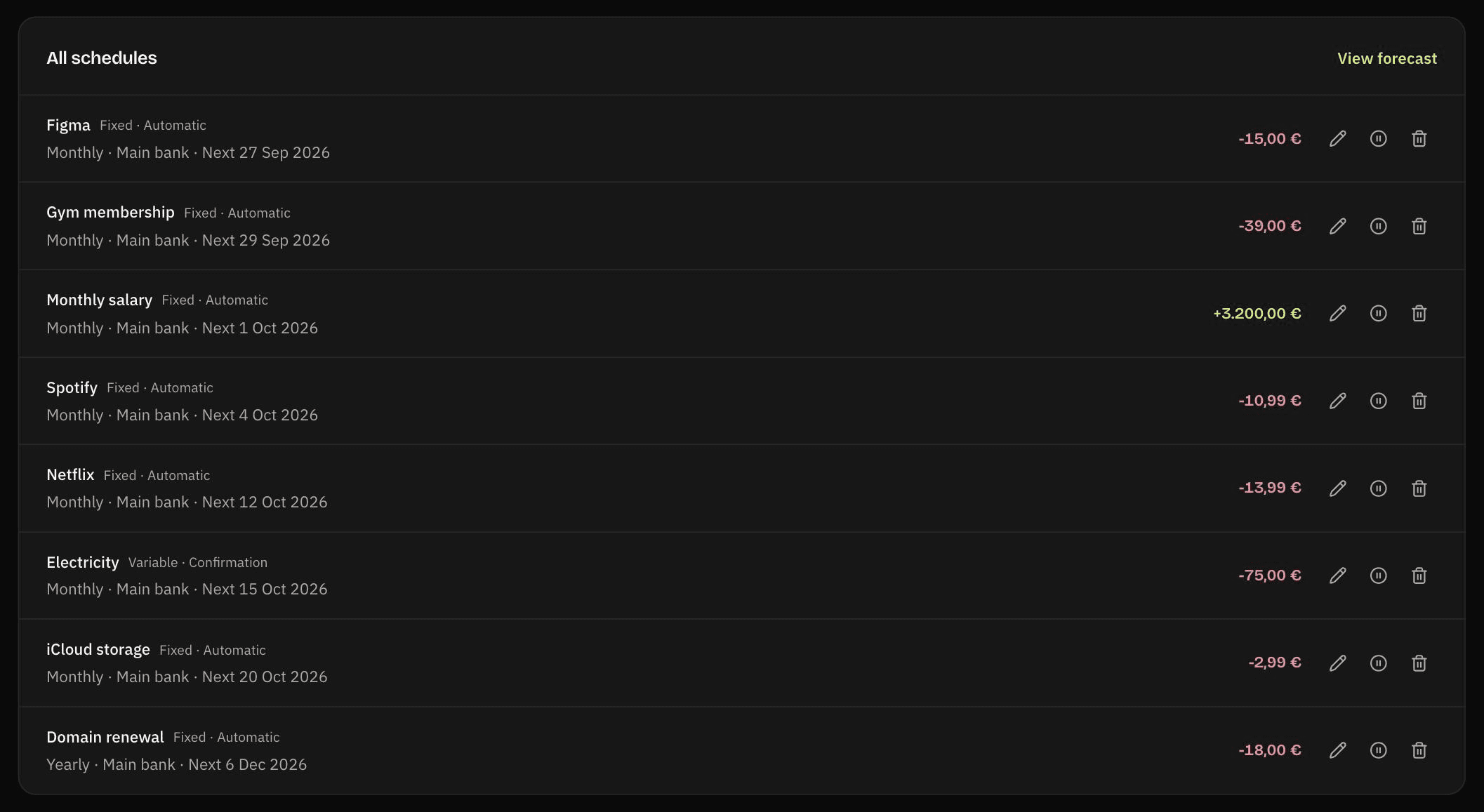
- Add the subscriptions you already pay for.
- Record transactions from that day forward.
For most people this is twenty to thirty minutes of setup. It is a genuine cost and worth weighing, particularly if the last few years of categorized history is something you rely on.
Which one to pick
Choose Goodbudget if the envelope method is what keeps you on track, if someone else shares the budget with you, or if you want the option of US bank sync later.
Choose Rinalance if you want unlimited records with no history cutoff, if you need to keep personal and business money in separate contexts, if you deal in more than one currency, or if you want your balances, debts, and subscriptions in one place without connecting a bank.
Both are manual by design. That part is a feature, not a limitation.